Modi dons traditional bandhani turban for Independence Day
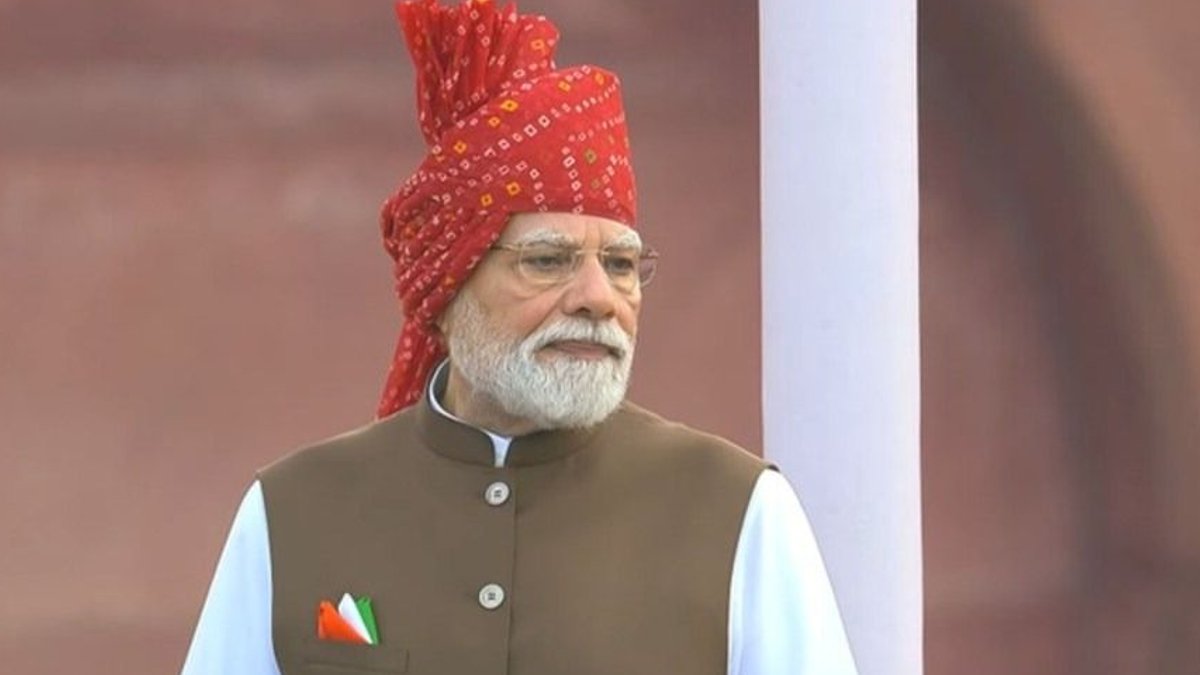
Prime Minister Narendra Modi continued his annual tradition of wearing a distinctive turban during India’s Independence Day celebrations on Saturday. This year, he appeared at the Red Fort in a deep maroon turban adorned with detailed yellow and white bandhani patterns, a design that subtly stood out against the neutral backdrop of his white kurta-pajama and brown Nehru jacket. The ensemble maintained the visual prominence of the turban as a central element of his attire.
Modi’s turban tradition since 2014
Modi’s practice of donning a unique turban for each Independence Day address began in 2014, his first as prime minister. That year, he selected a vivid green turban with red bandhej detailing, a style deeply rooted in Jodhpur’s textile heritage. The following year, he opted for a yellow turban featuring a multicolored crisscross pattern, a design that showcased the versatility of Rajasthan’s handloom techniques. Each subsequent year brought a new variation, with colors ranging from saffron and pink to bold reds and yellows, often drawing from the rich palette of western India’s traditional crafts.
The designs have consistently incorporated regional textile methods, particularly bandhani and lehariya. Bandhani, a tie-dye technique, involves tightly tying sections of fabric before dyeing to create precise, repetitive patterns, while lehariya produces diagonal or wavy stripes through a resist-dyeing process. These methods, passed down through generations of artisans, require meticulous skill and patience, with some patterns taking weeks to complete. The turbans have included designs featuring these patterns, with one instance where he wore a turban in the colors of the national flag.
The evolution of his turbans over the past decade reflects a deliberate engagement with India’s textile legacy. While the colors and patterns shift annually, the underlying theme remains tied to the craftsmanship of Rajasthan and Gujarat, regions renowned for their handloom traditions. This year’s maroon turban, with its delicate yellow and white bandhani accents, introduced a more subdued tone compared to the lively hues of previous years.
Related: Tata Group’s Future Shaped by Trusts and Family
Why the turban matters
Modi’s turbans extend beyond mere fashion; they serve as a deliberate acknowledgment of India’s diverse textile heritage, particularly the handloom traditions of Rajasthan and Gujarat. The recurring use of colors like saffron, red, and yellow is not arbitrary. In Indian culture, saffron symbolizes sanctity and sacrifice, red represents strength and auspiciousness, while yellow is often linked to knowledge and learning. The symbolic weight of these hues aligns with broader cultural narratives, subtly reinforcing themes of national identity and pride.
The tradition also intersects with efforts to promote indigenous crafts, many of which face challenges from industrialization and declining artisan communities. Rajasthan’s textile industry, a cornerstone of the state’s economy, relies heavily on techniques like bandhani and lehariya. These crafts are not only a source of livelihood for thousands of families but also a living sign to centuries-old traditions. By incorporating these designs into his Independence Day attire, Modi brings national attention to the craftsmanship, indirectly advocating for its preservation. The visibility of these turbans on a global stage—broadcast during a widely watched event—amplifies their cultural significance, offering a platform for artisans whose work might otherwise remain localized.
The turban has also become a recognizable element of Modi’s public persona during Independence Day. While the specific design changes each year, the consistency of the tradition has turned it into a small but meaningful ritual, one that viewers anticipate as part of the holiday’s visual narrative. This year’s maroon turban, with its refined bandhani detailing, provided a contrast to the more flamboyant designs of the past. The shift toward subtlety in 2024 may have been a deliberate choice to balance the attire with the gravity of the occasion, ensuring the focus remained on the speech while still honoring the textile heritage that defines the tradition.
The turban’s role in Modi’s Independence Day appearances shows a broader engagement with cultural representation. By wearing region-specific designs, he celebrates India’s diversity and signals support for local economies. The craftsmanship behind each turban involves multiple stages, from dyeing and tying to weaving and finishing, each step performed by skilled artisans. The selection of these turbans, therefore, carries an implicit endorsement of the handloom sector, which has historically struggled to compete with mass-produced textiles. In this context, the turban becomes more than an accessory—it is a statement of intent and a reminder of the enduring value of India’s artistic heritage.

Tata Group's Future Shaped by Trusts and Family


